
The IFC Classification Problem
Most project teams struggle with a fundamental openBIM challenge: how do you consistently classify building elements across 100+ IFC classes when most team members aren't BIM experts?
The consequences are significant:
Time Drain
Manual classification consumes 50-80% of model preparation time. Contractors routinely reclassify entire models between design stages.
Quality Issues
Misclassified elements create incomplete clash detection sets, inaccurate quantity take-offs, and coordination failures that propagate into construction.
Knowledge Barrier
The IFC schema's richness becomes its limitation—only technical specialists can leverage its full potential, forcing teams toward oversimplified models.
Cost Impact
Classification errors lead to rework, material waste, disputes, and lost trust in digital workflows.

Why traditional methods fail:
- Manual expert classification doesn't scale.
- Simple heuristic rules (identifying only beams, columns, walls) miss 90% of the IFC schema's value.
How QI Works
Simple Workflow:
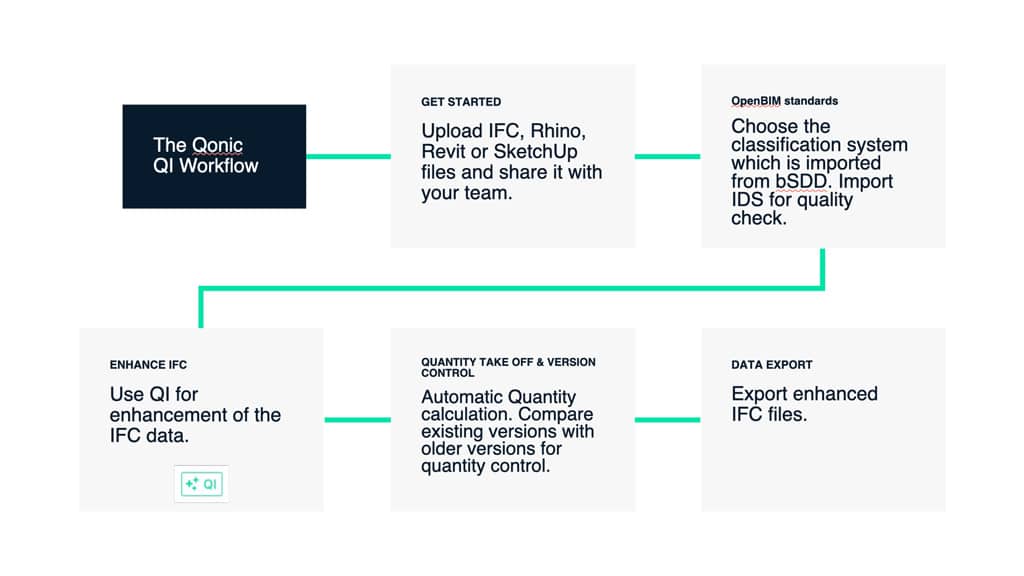
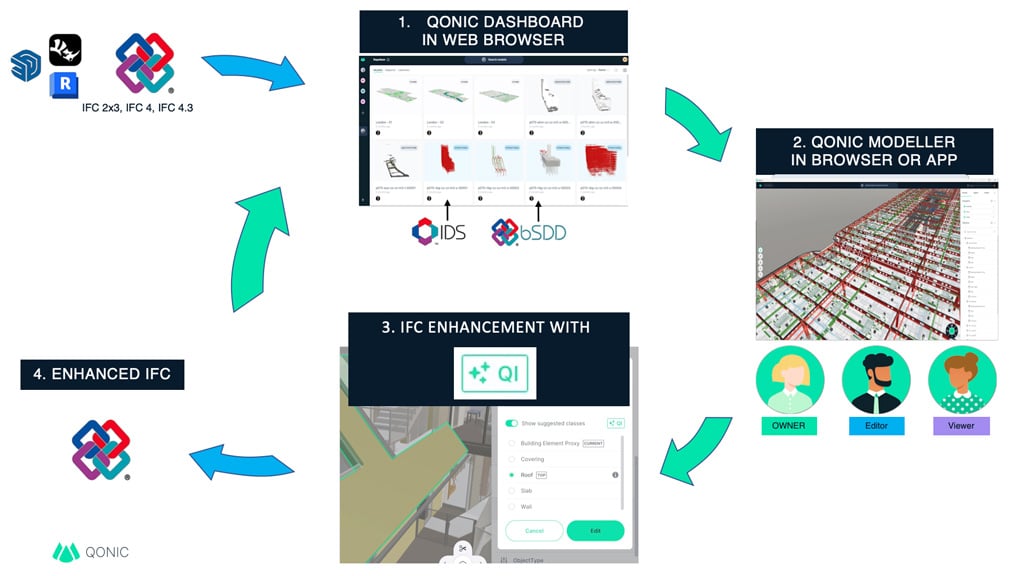
- Upload IFC file or native format (Revit, Rhino, SketchUp)
- QI analyzes at 100+ objects/second
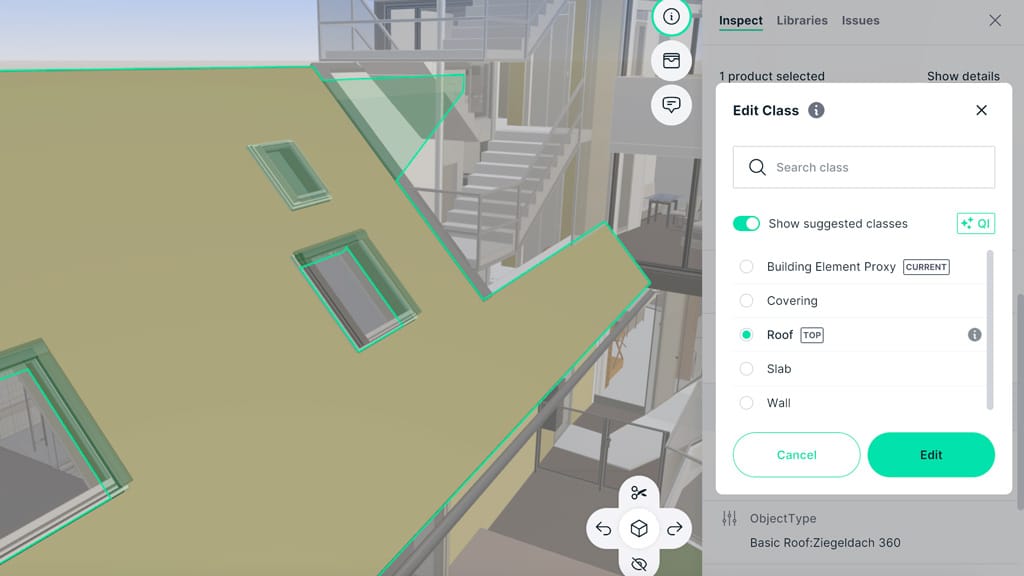
- Review top 5 classification suggestions with confidence scores
- High-confidence predictions auto-apply; uncertain cases prompt validation
- Corrections improve future classifications automatically
Real-Time Intelligence:
- Visual feedback shows classification reasoning
- Confidence scores indicate reliability
- One-click corrections for user control
- Client-side processing ensures data privacy

Time Savings
Faster model preparation for coordination and quantity take-offs
0%
Process Efficiency
- Vendor-agnostic: Works with 5+ authoring tools plus mesh geometry
- Scalable: Validated on federated models across all disciplines
- Energy-efficient: Client-side processing (<25MB) vs. cloud AI
Quality Improvements
- 98% accuracy even for ambiguous geometric shapes
- Measurable reduction in BCF coordination issues
- Complete clash detection sets through automated validation
Cost Reduction
- Eliminated repeat classification across disciplines
- Reduced construction rework from early error detection
- More reliable cost estimates from consistent quantity data
Sustainability Impact
- Lower carbon footprint from reduced rework and material waste
- Energy efficiency through compact, client-side models
- Extended data lifecycle with properly structured IFC models
What Made This Work
- Standardization enables AI — IFC's consistent structure was essential for training reliable models
- Purpose-built beats generic — Domain-specific architecture outperforms adapted solutions
- Real-world training matters — 8M+ elements from actual projects ensured robustness
- Continuous learning prevents obsolescence — Dynamic architecture stays current as technology evolves
- User feedback accelerates improvement — Corrections create a virtuous cycle
Critical Success Factors
- Build on open standards from day one
- Invest in domain expertise, not just data science
- Design for edge cases and imperfect data
- Make AI decisions transparent to build trust
- Create feedback loops for continuous improvement
Lessons for Your Organization
For Technology Developers:
Start with openBIM standards—proprietary approaches limit scale and lock users into specific ecosystems
For Project Teams:
Adopt classification validation early, before errors propagate downstream into coordination and construction
For Industry Leaders:
Recognize that AI doesn't replace expertise—it democratizes technical knowledge across entire project teams
Stakeholder Voices


About This Case Study
buildingSMART International publishes case studies to demonstrate the real-world value of openBIM standards and services including IFC, IDS, BCF, and bSDD. We showcase diverse implementations to inspire innovation and guide adoption.
Featured in this case study: Qonic NV (Belgium)
buildingSMART International does not endorse specific commercial products. Company information is provided for educational context. Organizations interested in similar approaches should evaluate multiple solutions and consult with openBIM professionals.
Explore buildingSMART Standards and Services Used in this Project



Success Stories
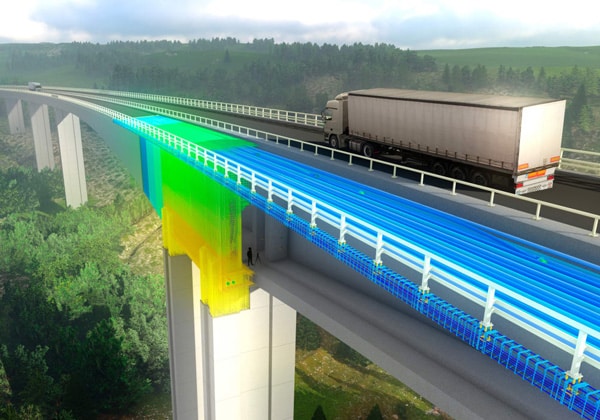
Sweco Norge - The Randselva Bridge
The Randselva Bridge is the world’s longest bridge built without the use of any drawings, only BIM models.

Auckland Airport - Foodstuffs HQ
Development of open digital standards and solutions for buildings across all sectors and throughout their lifecycle.

Project Pontsteiger
Project entailed more than 50 disciplines delivering IFC, over 350 unique IFC’s, and over 3500 different versions of IFC.